
Learn more from your colleagues about prescribing MOUD.

Fact Sheet: Buprenorphine for Opioid Use Disorder
Additional Resources on Buprenorphine
Additional MACS Materials and Fact Sheets
Accessible Format: Buprenorphine for Opioid Use Disorder
Starting Buprenorphine: Tips for Filling Your Prescription
Accessible Format: Starting Buprenorphine: Tips for Filling Your Prescription
High-Dose Buprenorphine: Clinical Considerations
Accessible Format: High-Dose Buprenorphine: Clinical Considerations
Accessible Format: Buprenorphine and Pain
Precipitated Withdrawl and Buprenorphine Induction
Accessible Format: Precipitated Withdrawal and Buprenorphine Induction
Buprenorphine Quick Start Guide
Past MACS Webinars
Starting Buprenorphine in the Fentanyl Era: Is Low dose Initiation (“Microdosing”) the Solution?
Devang Gandhi, MD, and Aaron Greenblatt, MD
February 23, 2022
2.23.22 Slides
Pain Management Webinar: Challenging Case Presentations and Discussion on the Use of Buprenorphine for Pain
Sarah Merritt, MD
November 12, 2021
11.12.21 Slides
Prescribing Buprenorphine for Chronic Pain
Sarah Merritt, MD
December 8, 2020
12.8.20 Slides
Buprenorphine Treatment in the Primary Care Setting: Cases and Clinical Issues
Aaron Greenblatt, MD
March 30, 2018
3.30.18 Slides
Patient-Related Materials
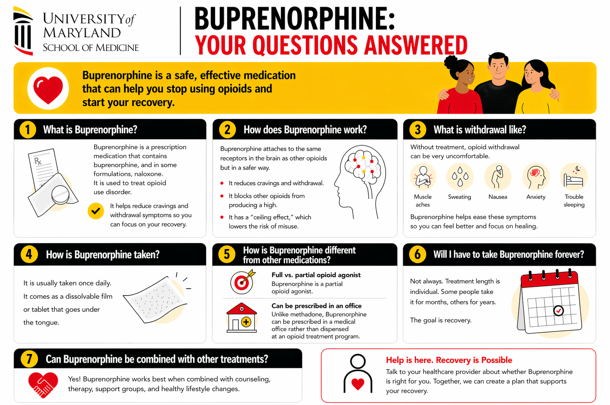
This patient-friendly handout from the University of Maryland School of Medicine provides a clear, accessible introduction to buprenorphine for individuals considering or beginning MOUD. It covers key topics including how buprenorphine works, what to expect during withdrawal, how the medication is taken and how it differs from other OUD treatments. The handout also emphasizes that buprenorphine works best as part of a comprehensive care plan that includes counseling, therapy and support groups.
Practice Guidance & Clinical Resources
Different Forms of Stigma and Rural Primary Care Professionals' Willingness to Prescribe Buprenorphine
This qualitative study identified three distinct forms of stigma influencing rural primary care providers' willingness to prescribe buprenorphine: stigma towards patients, stigma towards providers and stigma towards buprenorphine itself. These findings underscore the complex nature of stigma as a barrier to buprenorphine access in rural areas and suggest that implementation strategies must address these different forms of stigma to improve prescribing rates.
Buprenorphine Formulations: Clinical Best Practice Strategies Recommendations for Perioperative Management of Patients Undergoing Surgical or Interventional Pain Procedures (Pain Physician Journal)
The present investigation aims to review the literature and provide recommendations when encountering a patient on buprenorphine therapy who is scheduled for a surgical or interventional pain procedure.
Buprenorphine Home Induction App
An informative mobile application that guides patients on how to conduct buprenorphine induction using a series of questions that the patient is asked in the mobile application.
Buprenorphine Master Class: Managing Opioid Use Disorder for the Generalist
Get comfortable with counseling and pharmacotherapy for OUD with tips from MACS Consultant Michael Fingerhood, MD, on the Curbsiders, a CME podcast accredited by ACP.
Disparities in Treatment and Referral After an Opioid Overdose Among Emergency Department Patients
This study in JAMA Network Open highlights significant gaps in care for adults treated for opioid overdose in U.S. emergency departments. Researchers found that out of 1,683 patients, 42% received naloxone kits or prescriptions, just 8% were prescribed buprenorphine and only 18% were referred to outpatient treatment. The study also highlighted racial disparities, with Black patients significantly less likely than white patients to be referred to outpatient care. These figures reveal a missed opportunity to connect individuals with essential care immediately after an overdose.
Pharmacy Barriers to Receiving Buprenorphine Among Patients Undergoing Telemedicine Addiction Treatment
This study published in JAMA Network Open examines the challenges patients receiving telemedicine treatment for opioid use disorder (OUD) experience at the pharmacy level when filling buprenorphine prescriptions. A web-based survey of adults with OUD across five U.S. states found that approximately one-third of patients receiving telemedicine treatment were unable to get their buprenorphine prescriptions filled. The most common problems included insufficient pharmacy stock (55%), insurance coverage issues (22%) and pharmacies being hesitant to fill telemedicine prescriptions (19%). These buprenorphine prescription problems could have serious health consequences for rural and nonrural communities alike. Inconsistent access to medication can increase the risk of returning to non-prescribed opioid use and lead to harms like overdose.
Practical Tools for Prescribing and Promoting Buprenorphine in Primary Care Settings
Guidance and step-by-step tactics on implementing opioid use disorder treatment using buprenorphine.
Recommendations for Addressing In-Hospital Substance Use From a National Delphi Consensus Process
A study in JAMA Network Open outlines expert consensus recommendations for addressing substance use during hospitalization. Key recommendations include screening and treating substance use disorders (including offering medications), discussing pain and withdrawal management, respecting patient autonomy, providing harm-reduction supports, and using nonstigmatizing, patient-centered policies. This guidance highlights the need for hospitals to adopt evidence-based, nonpunitive approaches that prioritize safety, dignity and engagement in care.
Sublingual & Transmucosal Buprenorphine for OUD: Review and Update
This SAMHSA advisory summarizes data on the use of sublingual and transmucosal buprenorphine for the medication-assisted treatment of opioid use disorder.
Buprenorphine Treatment for Adolescents and Young Adults With Opioid Use Disorders: A Narrative Review
MACS Consultant and Child/Addiction Psychiatrist Dr. Marc Fishman, MD, is an author.
Retention in Opioid Agonist Therapy Among First Nations People
This study found low retention rates in opioid agonist therapy (OAT) among First Nations people in Ontario, with buprenorphine-naloxone showing shorter retention than methadone. It highlights the need for improved, culturally appropriate OAT services for First Nations communities.
JAMA Patient Page: Medications to Treat Opioid Use Disorder
This JAMA Patient Page provides a clear and accessible overview of the medications used to treat OUD, including buprenorphine, methadone and naltrexone.
Information on the MAT & MATE Acts

Fact Sheet: Methadone for Opioid Use Disorder
Additional Resources on Methadone
Additional MACS Materials and Fact Sheets
Accessible Format: Methadone for Opioid Use Disorder
Methadone "3-Day" Dispensing Rule
Accessible Format: Methadone "3-Day" Dispensing Rule
Transitioning From Methadone to Buprenorphine: General Guidance for Clinicians
Accessible Format: Transitioning From Methadone to Buprenorphine
Practice Guidance & Clinical Resources
Retention in Opioid Agonist Therapy Among First Nations People
This study found low retention rates in opioid agonist therapy (OAT) among First Nations people in Ontario, with buprenorphine-naloxone showing shorter retention than methadone. It highlights the need for improved, culturally appropriate OAT services for First Nations communities.
JAMA Patient Page: Medications to Treat Opioid Use Disorder
This JAMA Patient Page provides a clear and accessible overview of the medications used to treat OUD, including buprenorphine, methadone and naltrexone.
General MOUD Resources
MOUD Works for Me
Produced by the Calvert County Health Department, this site serves as a comprehensive digital resource to expand access to MOUD. It focuses on destigmatizing evidence-based treatments like buprenorphine and methadone by translating complex clinical concepts into accessible, human-centric language. By featuring real-life recovery testimonials, a directory of regional treatment centers, and specific guidance for healthcare providers, the platform acts as a low-barrier entry point for anyone seeking to understand how medical intervention can stabilize brain chemistry and support long-term recovery.